
December 6, 2025
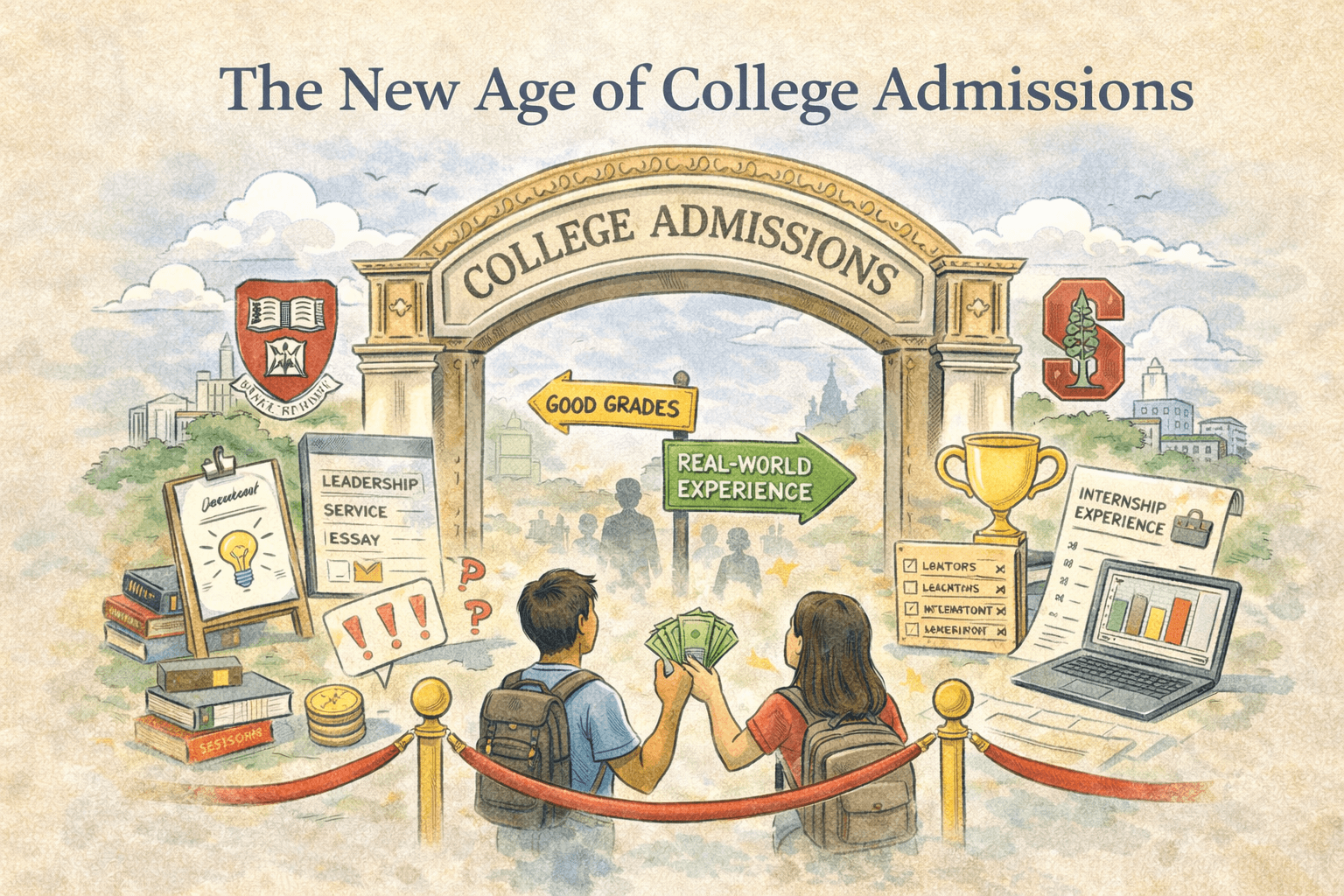
Over the past two decades, college admissions at top universities have become dramatically more competitive. Acceptance rates at institutions such as Harvard University, Stanford University, and Massachusetts Institute of Technology now sit below 5–7%, even as the academic strength of the applicant pool has steadily increased.
Today, a large share of applicants present near-perfect GPAs, rigorous coursework, and strong standardized test scores (where applicable). As a result, academic excellence - once a differentiator - has become a baseline requirement.
So how do admissions officers distinguish among thousands of academically qualified applicants?
Good grades are a basic requirement, we need to empower our children to stand out with real impact
In response to this saturation of academic achievement, selective colleges have increasingly prioritized agency—the demonstrated ability to identify a problem, take initiative, and follow through in the real world.
MIT articulates this particularly clearly, noting: “We are not looking for students who have done everything right; we are looking for students who have done something interesting with their opportunities.” In other words, admissions officers are not merely evaluating what students have achieved, but how they have chosen to act when faced with opportunity, ambiguity, or constraint.
A former Stanford Dean of Admissions described the strongest applicants as those who “see a problem, care deeply about it, and do something about it—often without being asked.” This framing shifts the focus away from résumé-building and toward ownership: Who took responsibility for creating change? Who initiated action rather than waiting for instruction? Who stayed committed long enough to produce tangible outcomes?
What “impact” actually means
Importantly, admissions officers are not narrowly looking for polished success stories or large-scale wins. Impact is not measured by prestige alone. Rather, it is assessed through depth, persistence, and evidence of learning. This might take the form of launching a small venture or nonprofit, conducting original research, building a product, organizing a community initiative, or meaningfully improving an existing organization.
This is why admissions guidance consistently emphasizes sustained commitment over scattered participation. A long list of clubs and awards signals involvement, but not necessarily grit and ambition. By contrast, a single initiative pursued over time, especially one that required iteration, failure, and adaptation, provides admissions officers with a much clearer signal of how a student thinks and acts.
Universities are not just admitting students; they are selecting future researchers, founders, leaders, and changemakers. Academic performance predicts the ability to handle coursework. Agency predicts what students will do once they arrive on campus—and beyond. Students who have already demonstrated the capacity to move from insight to action are far more likely to contribute meaningfully to classrooms, labs, student organizations, and broader communities.
In this sense, admissions decisions have become less about identifying “the smartest students” and more about identifying students who behave like builders: those who take initiative, navigate ambiguity, and translate ideas into reality.
The new signal of success
The takeaway for students and families is clear. In today’s admissions landscape, excellence in school is assumed. What differentiates applicants is evidence of self-directed action - proof that a student can engage with the world as it is, not just succeed within predefined academic structures.
As competitive pressure continues to rise, this trend is unlikely to reverse. If anything, the signal is becoming sharper: universities are looking for students who have already begun to practice the habits of impact. Not because they were told to, but because they chose to.